



Industrial piping systems used in power plants, refineries, and
petrochemical facilities operate under conditions where both temperature and pressure remain
consistently high for long durations. Under these demanding environments, materials supplied
by an
ASTM A335 P22 Seamless Pipe Stockist are widely used because of their ability to
maintain structural integrity during elevated-temperature service conditions. Standard
carbon steel piping can gradually lose strength, experience oxidation, and become vulnerable
to long-term deformation when exposed to sustained heat. To improve reliability and
operational safety in these severe environments, industries rely on alloy steel materials
specifically engineered for high-temperature service.
ASTM A335 P22 is a seamless ferritic alloy steel pipe designed for elevated-temperature
applications and is commonly referred to as a Chrome-Moly pipe because of its chromium and
molybdenum content. The material is extensively used in critical piping systems where
long-term thermal stability, pressure resistance, and structural integrity are essential.
Understanding ASTM A335 P22 Pipe
What Does ASTM A335 Mean?
ASTM A335 is a standard specification developed for seamless ferritic alloy-steel pipes
intended for high-temperature applications. The specification covers multiple alloy steel
grades used across industries where piping systems are exposed to elevated heat and pressure
conditions. It establishes requirements related to chemical composition, mechanical
properties, manufacturing methods, heat treatment, and testing procedures.
The specification is widely referenced in industries such as thermal power generation, oil
refining, petrochemical processing, and heavy engineering because these sectors require
materials capable of maintaining performance stability during prolonged thermal
exposure.
Rather than functioning as a general-purpose piping material standard, ASTM A335 is
specifically intended for applications where resistance to creep, oxidation, and
high-temperature stress becomes operationally important.
What is Grade P22?
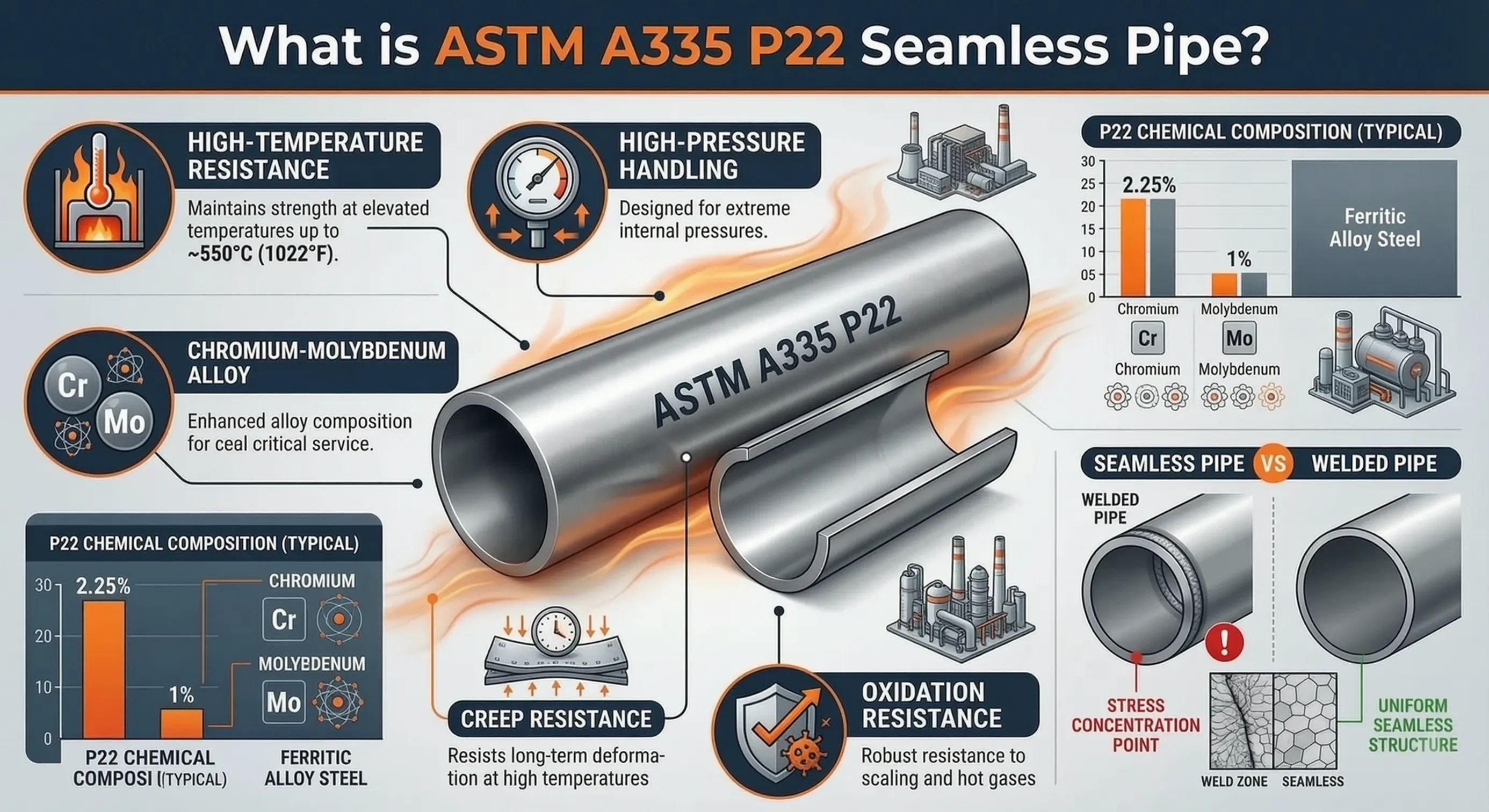
Within the ASTM A335 specification, P22 refers to a chromium-molybdenum alloy steel grade
containing nominally 2.25% chromium and 1% molybdenum. This chemical composition improves
the material’s resistance to oxidation and enhances its ability to retain mechanical
strength at elevated temperatures.
Industries sourcing
ASTM A335 P22 Pipe materials typically prioritize creep resistance,
oxidation resistance, and long-term thermal stability because these properties directly
influence piping reliability in severe operating environments.
The addition of chromium helps reduce surface scaling and improves oxidation resistance
during thermal exposure, while molybdenum contributes to creep resistance and
high-temperature stability. Because of these characteristics, ASTM A335 P22 is commonly
selected for steam piping systems, boilers, superheaters, and process piping networks
operating under sustained thermal loads.
Why Seamless Construction Matters
The term “seamless” indicates that the pipe is manufactured without welded joints. Seamless
pipes are typically produced from solid steel billets through piercing and extrusion
processes, resulting in a continuous pipe structure throughout the wall thickness.
In high-pressure and high-temperature environments, welded seams can become potential stress
concentration zones during thermal cycling or fluctuating pressure conditions. Seamless
construction minimizes this concern by providing greater structural uniformity across the
pipe body.
For critical industrial systems where operational reliability is essential, seamless alloy
steel pipes are often preferred because they offer improved integrity under demanding
service conditions.
| Term | Meaning | Industrial Significance |
| ASTM A335 | Standard specification for seamless ferritic alloy-steel pipe | Defines requirements for high-temperature service |
| P22 | Chromium-molybdenum alloy steel grade | Improves thermal strength and creep resistance |
| Seamless | Pipe manufactured without welded joints | Enhances structural reliability |
Material Composition and Mechanical Properties
Chemical Composition of ASTM A335 P22
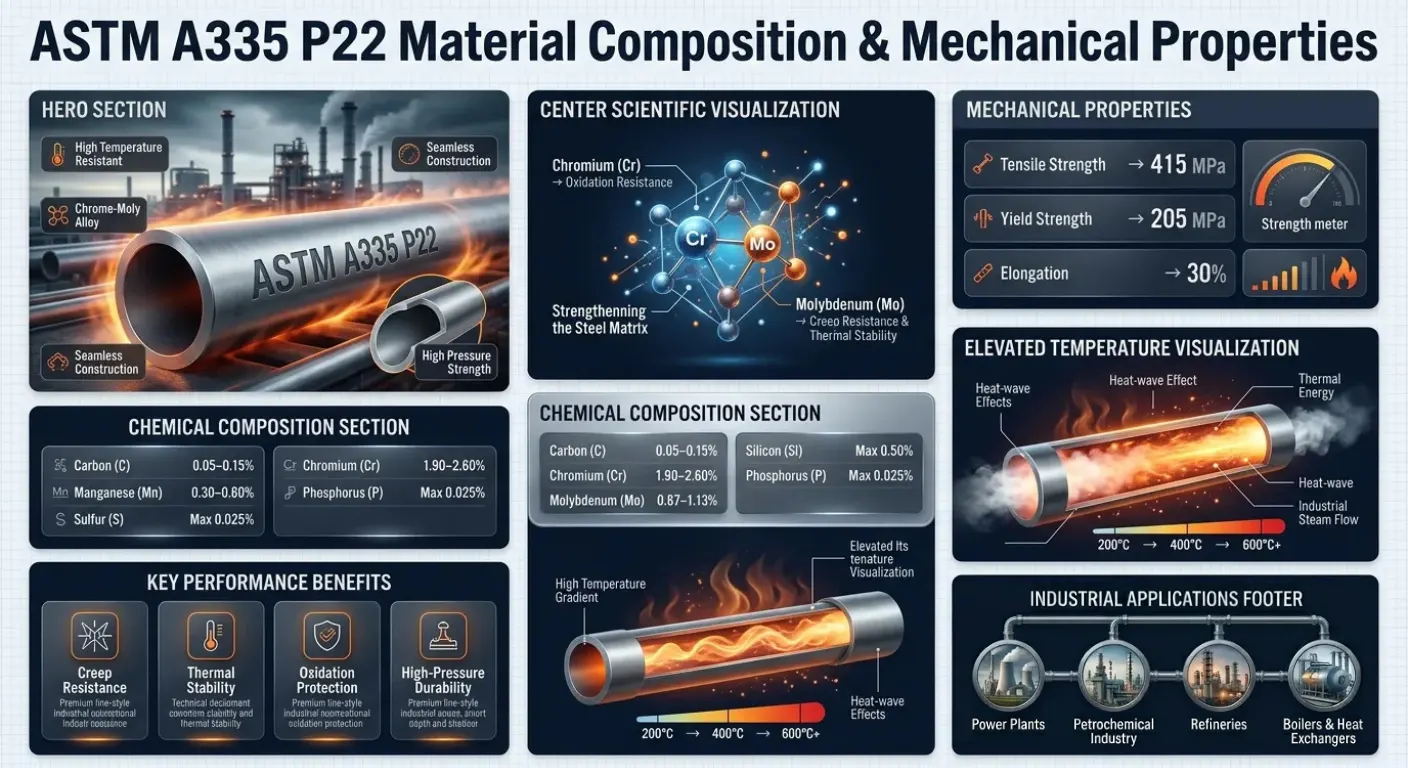
The performance characteristics of ASTM A335 P22 are primarily influenced by its alloying
composition. Chromium and molybdenum are the key elements responsible for improving
oxidation resistance, creep resistance, and elevated-temperature strength.
According to ASTM specifications, the material contains controlled percentages of alloying
elements to ensure consistent performance in high-temperature applications.
| Element | Composition Range (%) |
| Carbon (C) | 0.05 – 0.15 |
| Manganese (Mn) | 0.30 – 0.60 |
| Silicon (Si) | Max 0.50 |
| Chromium (Cr) | 1.90 – 2.60 |
| Molybdenum (Mo) | 0.87 – 1.13 |
| Phosphorus (P) | Max 0.025 |
| Sulfur (S) | Max 0.025 |
Exact composition requirements should always be verified against the latest ASTM standards and project specifications before procurement or application.
Mechanical Properties of P22 Pipe
In addition to alloy composition, ASTM A335 P22 is valued for its mechanical strength under
elevated-temperature service conditions. The material is designed to maintain structural
integrity under internal pressure and prolonged thermal stress.
Mechanical property requirements specified under ASTM standards include tensile strength,
yield strength, and elongation values that support its use in demanding industrial
environments.
| Mechanical Property | Minimum Requirement |
| Tensile Strength | 415 MPa |
| Yield Strength | 205 MPa |
| Elongation | 30% |
These properties contribute to the material’s suitability for steam lines, pressure piping systems, and thermal process applications.
Role of Chromium and Molybdenum
Chromium plays a major role in improving oxidation resistance and
reducing scaling during high-temperature operation. When exposed to elevated heat, chromium
helps form a protective oxide layer on the material surface, which slows further
oxidation.
Molybdenum improves creep resistance and enhances the alloy’s ability to maintain strength
during prolonged exposure to thermal stress. This becomes particularly important in piping
systems operating continuously at elevated temperatures where gradual material deformation
can occur over time.
The combined chromium-molybdenum alloy system is the reason ASTM A335 P22 is commonly
classified as a Chrome-Moly steel grade across industrial applications.
Key Characteristics of ASTM A335 P22
High-Temperature Strength
One of the primary advantages of ASTM A335 P22 is its ability to
retain mechanical stability in elevated-temperature environments. Standard carbon steel
materials can experience strength reduction when exposed to prolonged heat, whereas
chromium-molybdenum alloy steels are specifically engineered to improve thermal
performance.
This characteristic makes P22 suitable for industrial systems where pipes remain exposed to
continuous high-temperature operating conditions for extended service periods.
Creep and Oxidation Resistance
Creep refers to the gradual deformation of a material caused by
long-term exposure to stress at elevated temperatures. In steam and process piping systems,
creep resistance is critical because excessive deformation can eventually compromise piping
integrity.
ASTM A335 P22 offers improved creep resistance due to its molybdenum content. At the same
time, chromium enhances oxidation resistance and helps minimize scale formation on the pipe
surface during thermal exposure.
These characteristics contribute to improved operational reliability and reduced maintenance
requirements in critical industrial systems.
Pressure Handling Capability
Industrial steam and process piping systems are frequently subjected
to substantial internal pressure loads. Materials used in these applications must maintain
structural integrity while resisting both thermal and mechanical stress.
ASTM A335 P22 provides the strength and durability required for these demanding
environments. Its seamless construction further supports pressure-handling capability by
eliminating welded joints that may otherwise act as localized stress points.
To understand the broader industrial deployment of this material across energy, refinery,
and thermal processing sectors, readers can also explore the Applications of ASTM A335 P22
Pipes guide for more detailed operational use cases.
| Property | Operational Advantage |
| High-Temperature Stability | Supports prolonged thermal service |
| Creep Resistance | Reduces long-term deformation |
| Oxidation Resistance | Minimizes surface scaling |
| Structural Strength | Supports pressure-intensive systems |
Common Applications of ASTM A335 P22 Pipes
Power Generation Industry
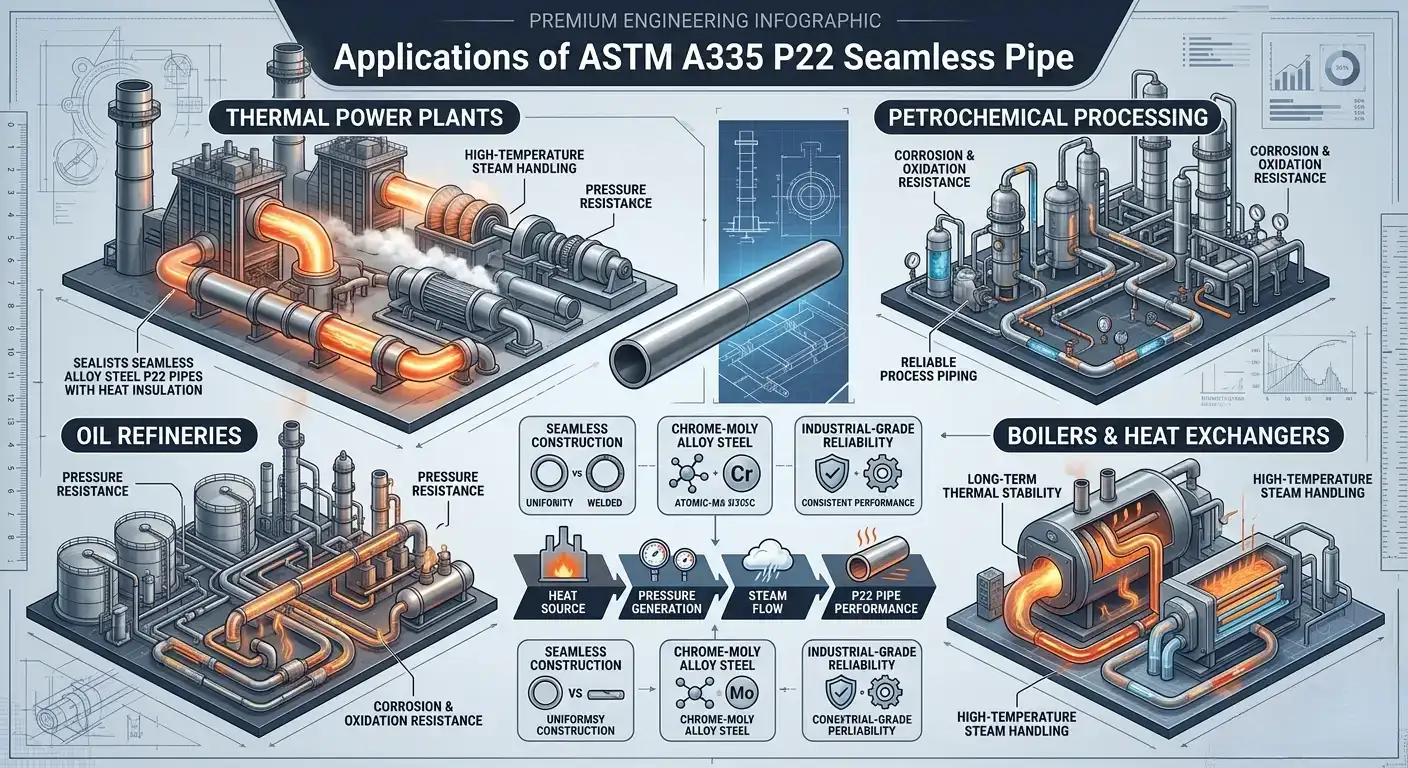
ASTM A335 P22 seamless pipes are extensively used in thermal power
plants where piping systems are exposed to elevated steam temperatures and sustained
pressure conditions. The material is commonly applied in main steam lines, reheater systems,
and superheater piping networks.
These systems require materials capable of maintaining structural reliability during
continuous thermal operation, making chromium-molybdenum alloy steel an important choice for
power generation infrastructure.
Petrochemical and Refinery Systems
Refineries and petrochemical facilities use ASTM A335 P22 pipes in
process piping systems that transport high-temperature fluids and gases. These operating
environments often involve aggressive thermal conditions where oxidation resistance and
high-temperature strength become essential.
The material is frequently selected for process heaters, catalytic units, and other
high-temperature piping applications where long-term operational stability is required.
Heat Exchangers and Boilers
Boilers and heat exchanger systems rely on materials capable of handling repeated heating and cooling cycles while maintaining mechanical performance. ASTM A335 P22 is widely used in these applications because of its resistance to thermal stress and elevated-temperature degradation. Its seamless construction and alloy composition contribute to improved durability in systems where thermal efficiency and pressure containment are critical operational considerations.
Procurement and Quality Considerations
Importance of Material Certification
Material certification plays a critical role in ensuring that ASTM
A335 P22 pipes comply with applicable specifications and project requirements. Buyers
typically review Mill Test Certificates (MTCs) to verify chemical composition, mechanical
properties, and manufacturing compliance.
Traceability markings and inspection documentation are also important because they help
confirm material authenticity throughout the supply chain.
Heat Treatment and Testing Requirements
ASTM A335 P22 pipes are generally supplied in heat-treated conditions to achieve the required mechanical and metallurgical properties. Heat treatment processes influence creep resistance, strength, and long-term thermal performance. Industrial projects may also require additional inspection procedures such as hydrostatic testing, non-destructive examination, and dimensional verification before material acceptance. Proper testing and quality control help reduce the risk of material inconsistencies in critical piping applications.
Choosing a Reliable Supplier
Working with an experienced P22 Seamless Pipe Stockist is important for verifying material traceability, certification compliance, dimensional accuracy, and inspection standards. Industrial buyers often evaluate suppliers based on manufacturing capability, testing infrastructure, documentation practices, and quality assurance systems. For high-temperature alloy steel piping systems, procurement decisions directly influence operational reliability and long-term service performance.
| Quality Factor | Why It Matters |
| Mill Test Certificates | Confirms specification compliance |
| Heat Treatment Records | Verifies metallurgical properties |
| Inspection Reports | Supports quality assurance |
| Traceability | Improves material verification |
Conclusion
ASTM A335 P22 seamless pipe is widely recognized as a reliable alloy
steel material for high-temperature and high-pressure industrial piping systems. Its
chromium-molybdenum composition improves creep resistance, oxidation resistance, and
elevated-temperature strength, making it suitable for demanding operational
environments.
From thermal power plants and refinery systems to boilers and process piping networks, ASTM
A335 P22 continues to play an important role in applications where long-term thermal
reliability and structural integrity are essential. Its seamless construction further
enhances performance by improving uniformity and minimizing potential weak points within the
piping structure.
For industries operating critical thermal systems, selecting certified ASTM A335 P22
seamless pipes from reliable suppliers remains essential for ensuring operational safety,
durability, and long-term system performance.